Probiotics 101
How to read a probiotic Supplement Facts label, line by line
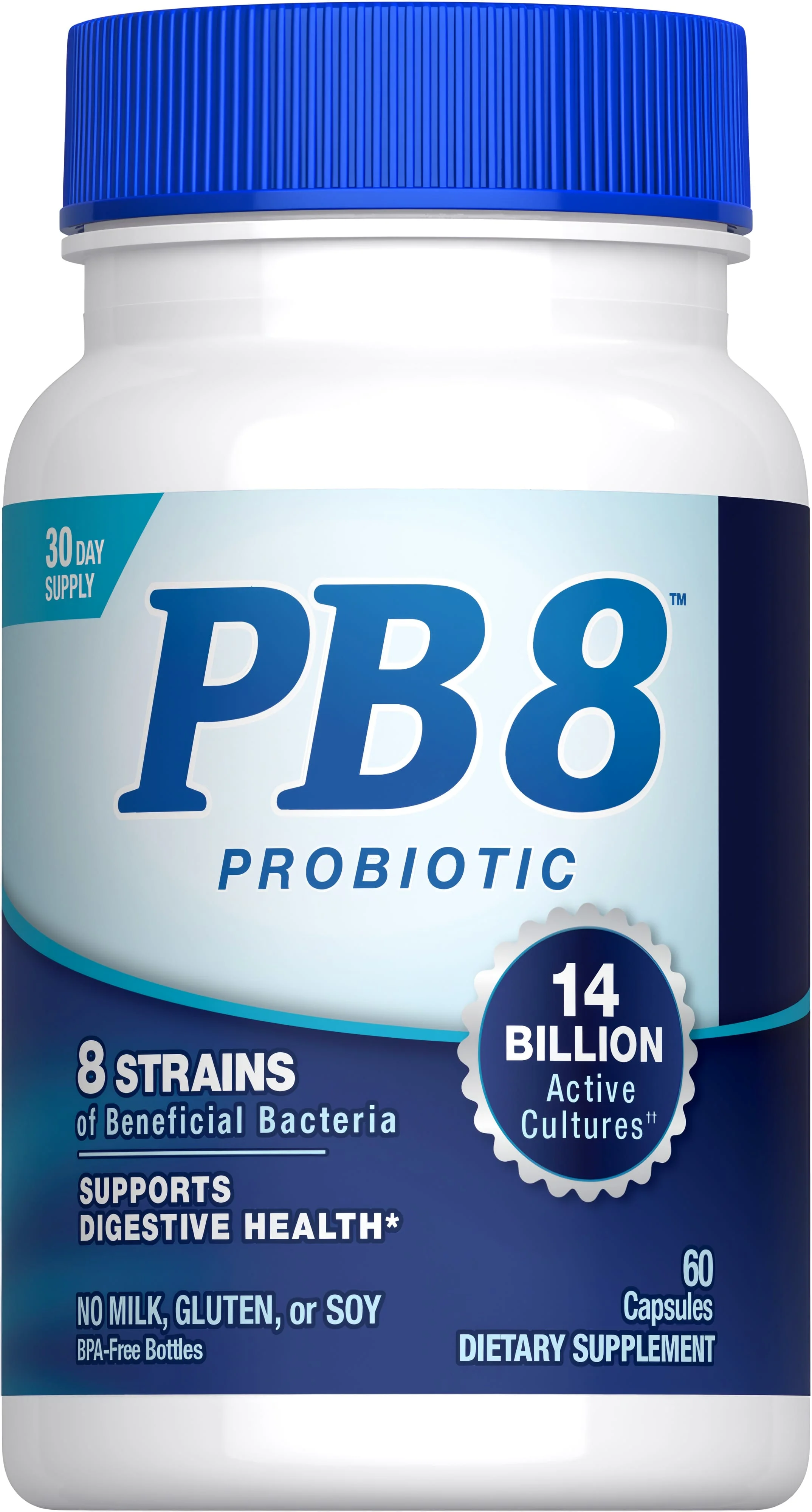
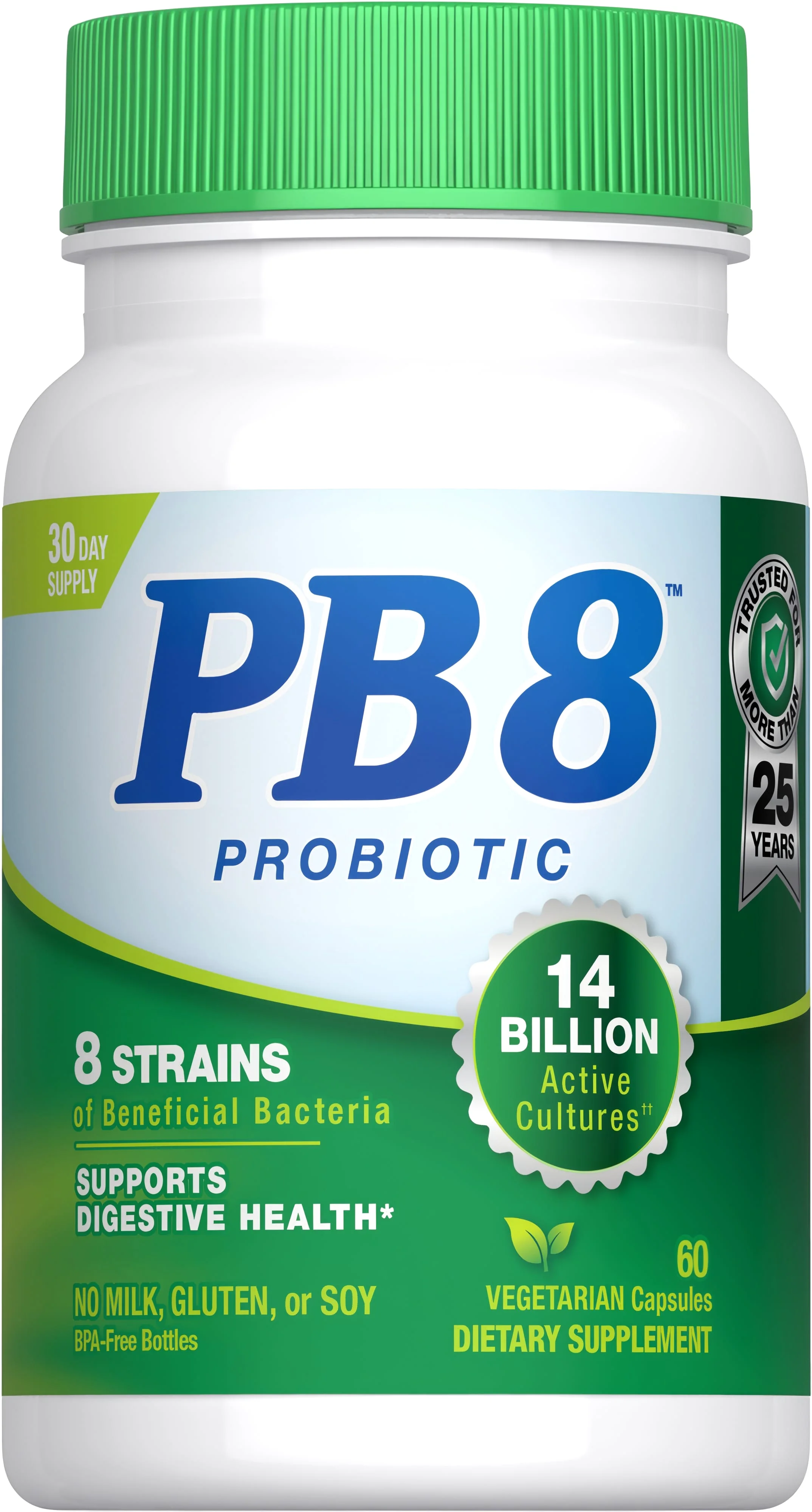
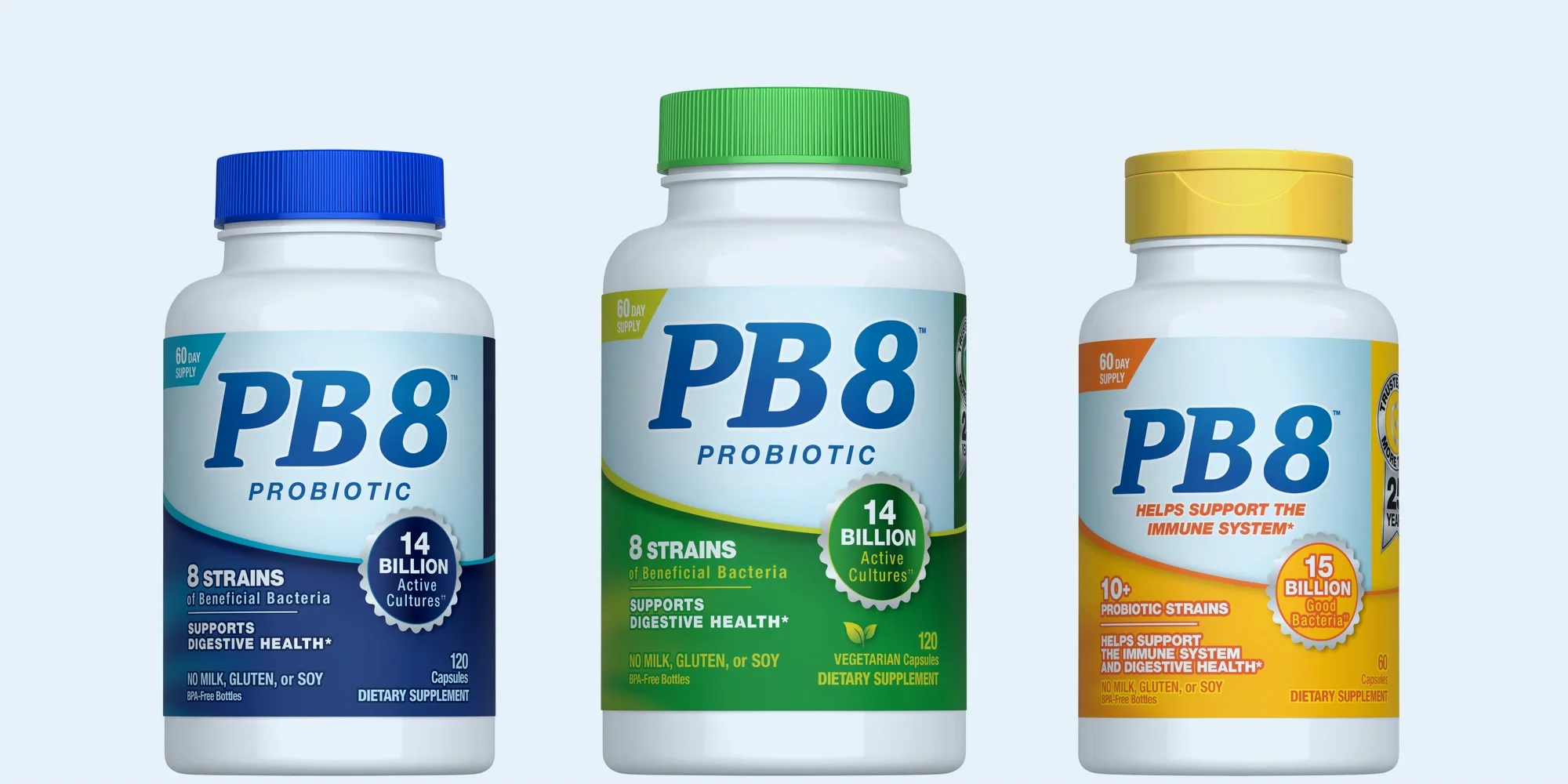
A probiotic label is short, and every line on it does a job. Here is how to read one from the top down, with the six PB8 labels as the worked example, so that you can hold any bottle on the shelf to the same questions.
Start with the serving size
The first line under the words "Supplement Facts" tells you how many capsules make one serving. Every number further down the panel is per serving, not per capsule, so this line decides how you read all the others. On our Original and Vegetarian labels a serving is two capsules. On Immune Support, the Synbiotic 3-1 and the Women's formula it is one. On the Vaginal formula it is two delayed release capsules.
That one line also decides how long a bottle lasts. A bottle of 120 Original capsules is 60 servings, two months at the label serving, while a bottle of 30 Synbiotic 3-1 capsules is one month. Before you compare two bottles by price, divide each price by the days the bottle lasts. Every card in the PB8 catalog does that sum for you and prints the price per day.
| Formula | Serving | Days per bottle |
|---|---|---|
| PB8 Original | 2 Capsules | 30 or 60 |
| PB8 Vegetarian | 2 Capsules | 30 or 60 |
| PB8 Immune Support | 1 Capsule | 60 |
| PB8 Synbiotic 3-1 | 1 Delayed Release Capsule | 30 |
| PB8 Women's | 1 Delayed Release Capsule | 30 |
| PB8 Vaginal | 2 Delayed Release Capsules | 30 |
Read the CFU line, and its footnote
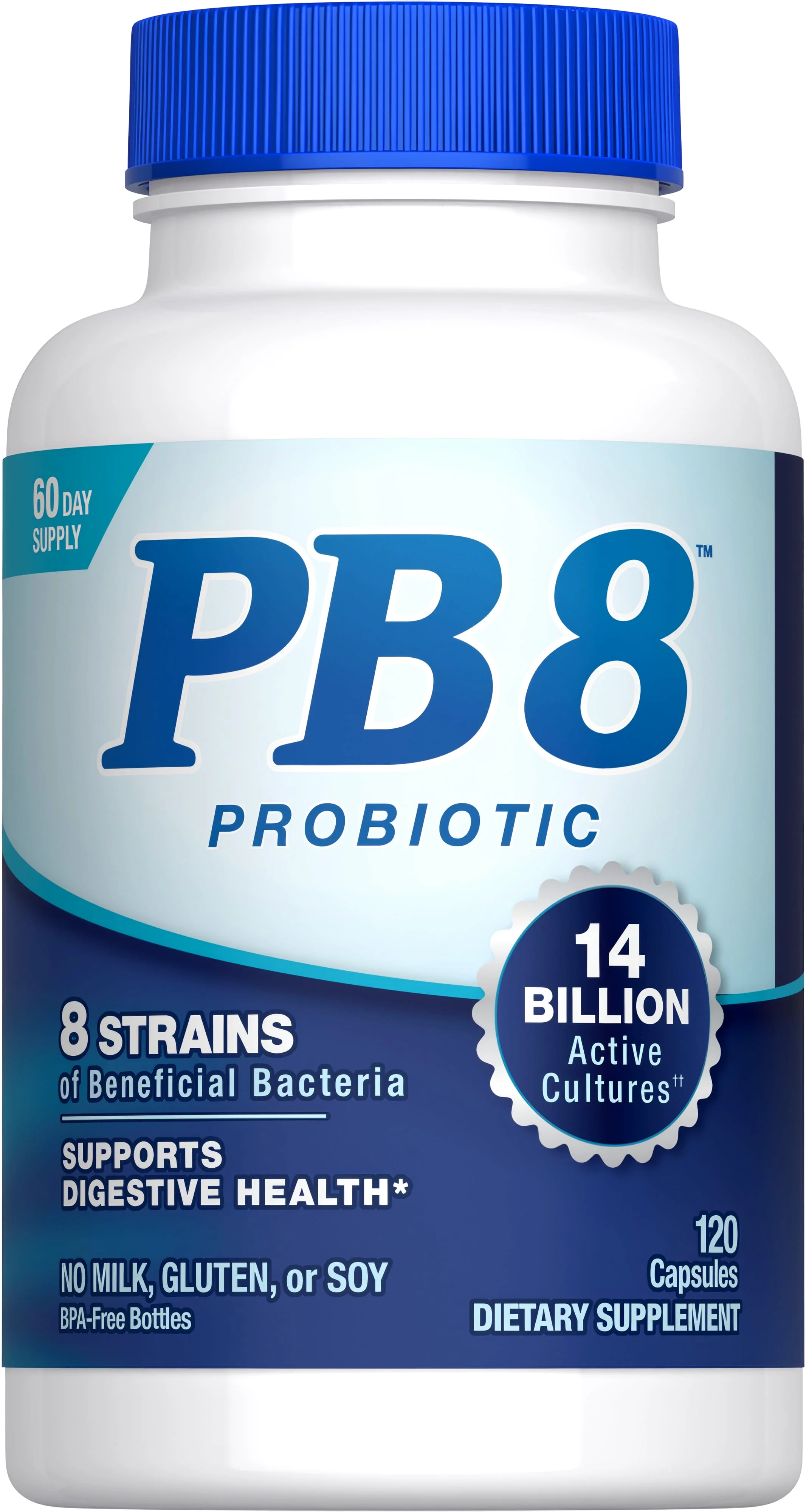
Probiotic labels count live microorganisms in colony-forming units, CFU. On our labels the count sits inside the blend line of the table: "Proprietary Probiotic Blend - 14 billion CFU" on the Original, "31 Strain Proprietary Probiotic Blend - 65 billion CFU" on the Synbiotic 3-1. The 3-in-1 labels add one more line under it, "Total Probiotic & Postbiotic Cultures", with the same number.
Then look for the mark after the number. Ours is a double dagger, and its footnote at the bottom of the panel reads: "14 billion good bacteria per serving at time of manufacture. Bacteria count will vary after time of manufacture." That sentence tells you when the count was true. Some labels on the shelf date their count from the other end, the day printed on the bottle. Those are two different promises, and it is worth knowing which one a label makes before you set two bottles side by side.
A bigger number is not a better product by itself. The count tells you how many organisms are in a serving, not which ones, and the next lines of the panel are about which ones.
The proprietary blend and its strain list
A proprietary blend is a mix of ingredients sold under one name with one weight. The FDA labeling guide sets out how it is printed: the name of the blend with the total weight of its ingredients on the same line, then the ingredients underneath in descending order of predominance by weight, then a symbol for the footnote "Daily Value Not Established". That is exactly the shape of our panels. The Original's blend weighs 755 mg and lists its eight strains along with microcrystalline cellulose, magnesium stearate and silicon dioxide.
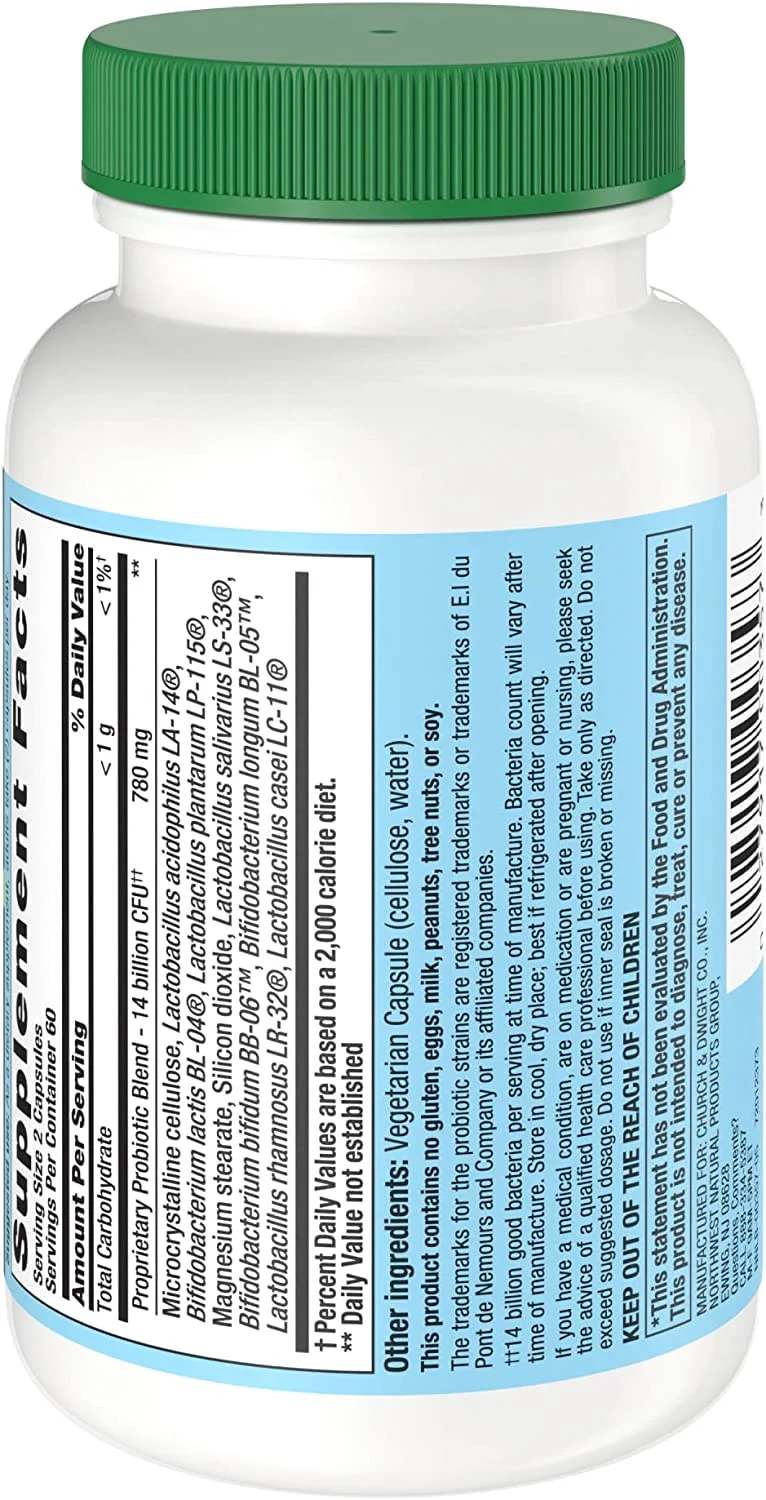
The list is where the formula lives. Each strain is printed in three parts: the genus, the species and the strain code. On the Original you can read Lactobacillus acidophilus La-14, Bifidobacterium lactis Bl-04, Lactobacillus plantarum UF-217, Bifidobacterium lactis BLa80, Bifidobacterium lactis HN019, Lactobacillus rhamnosus GG, Bifidobacterium lactis Bi-07 and Lactobacillus acidophilus NCFM.
Serving Size 2 Capsules
Servings Per Container 60
| Amount Per Serving | % Daily Value | |
|---|---|---|
| Total Carbohydrate | < 1 g | < 1%† |
| Proprietary Probiotic Blend - 14 billion CFU†† | 755 mg | ** |
Blend: microcrystalline cellulose, the eight strains below, magnesium stearate and silicon dioxide.
- Lactobacillus acidophilus La-14®
- Bifidobacterium lactis Bl-04®
- Lactobacillus plantarum UF-217
- Bifidobacterium lactis BLa80
- Bifidobacterium lactis HN019™
- Lactobacillus rhamnosus GG
- Bifidobacterium lactis Bi-07®
- Lactobacillus acidophilus NCFM®
† Percent Daily Values are based on a 2,000 calorie diet. ** Daily Value not established.
Other ingredients: Capsule and Inulin.
Contains no: gluten, eggs, milk, peanuts, tree nuts, or soy.
†† 14 billion good bacteria per serving at time of manufacture. Bacteria count will vary after time of manufacture.
Store in a cool, dry place; best if refrigerated after opening.
What a blend line does not give you is a weight for each strain. If a label lists eight strains under one total, you know which strains are there, not how much of each. Our labels are written the same way, and so are most multi-strain probiotics on the shelf.
Why the strain code matters
Two bottles can both say "Lactobacillus rhamnosus" and hold two different strains. The code is what tells them apart. The International Scientific Association for Probiotics and Prebiotics notes that different strains have different effects, as shown in scientific studies, and the National Center for Complementary and Integrative Health puts it plainly: if one kind of Lactobacillus helps, that does not mean another kind of Lactobacillus would do the same. So when you read about a probiotic somewhere, check whether the strain was named, and whether that strain is the one on your bottle.
Our strain map shows every strain on our six labels and which formulas carry it. One strain appears on all six: Lactobacillus rhamnosus GG. The two women's formulas share Lactobacillus reuteri RC-14 and Lactobacillus rhamnosus GR-1. You can see the whole grid on the PB8 strain page.
A small registered or trademark sign after a code means the strain name belongs to the company that owns the strain. Each PB8 label names that company, for example International Flavors & Fragrances or Chr. Hansen.
Daily Value, two stars and "other ingredients"
The column on the right of the table is the % Daily Value. Probiotic cultures and prebiotic fiber blends have no Daily Value set, so the column shows two stars and a footnote: "Daily Value not established". It is not a missing number. There is simply no reference amount to compare against, and the FDA guide asks for that footnote.
Under the table, "Other ingredients" lists what is in the capsule besides the active blend. On the Original that line reads "Capsule and Inulin", and the prebiotic, from chicory root, sits right there. On the 3-in-1 formulas the prebiotic fiber gets a line of its own in the table, with its weight.
| Formula | Prebiotic | Where on the label |
|---|---|---|
| PB8 Original and Vegetarian | Inulin from chicory root | Other ingredients |
| PB8 Immune Support | Organic acacia, organic oat hull fiber | Other ingredients |
| PB8 Synbiotic 3-1 | Acacia, oat hull and rice fiber, rice extract, 100 mg | Facts table |
| PB8 Women's | Acacia and oat hull fiber, 285 mg | Facts table |
| PB8 Vaginal | Beet root, acacia, cranberry, XOS, 600 mg | Facts table |
Read the "Contains no" line too. Every one of our labels says the formula contains no gluten, eggs, milk, peanuts, tree nuts or soy. The capsule itself differs: a classic capsule on the Original, plant cellulose and water on the Vegetarian, hypromellose and gellan gum on the delayed release 3-in-1 formulas.
The claim, the asterisk and the FDA statement
The words on the front of a supplement, such as "helps support digestive health", are structure/function claims. The FDA explains that such claims are not pre-approved by the agency, that the manufacturer must have substantiation that the claim is truthful and not misleading, and that the label must then carry a disclaimer that the FDA has not evaluated the claim and that the product is not intended to diagnose, treat, cure or prevent any disease. On our labels that statement sits under an asterisk, and it is printed under every claim on this site too.
A claim like that is never a promise about a disease. The National Center for Complementary and Integrative Health makes the same distinction for probiotics: a supplement label may describe how the product affects the structure or function of the body, but may not say it lowers your risk of a disease without the FDA's consent.
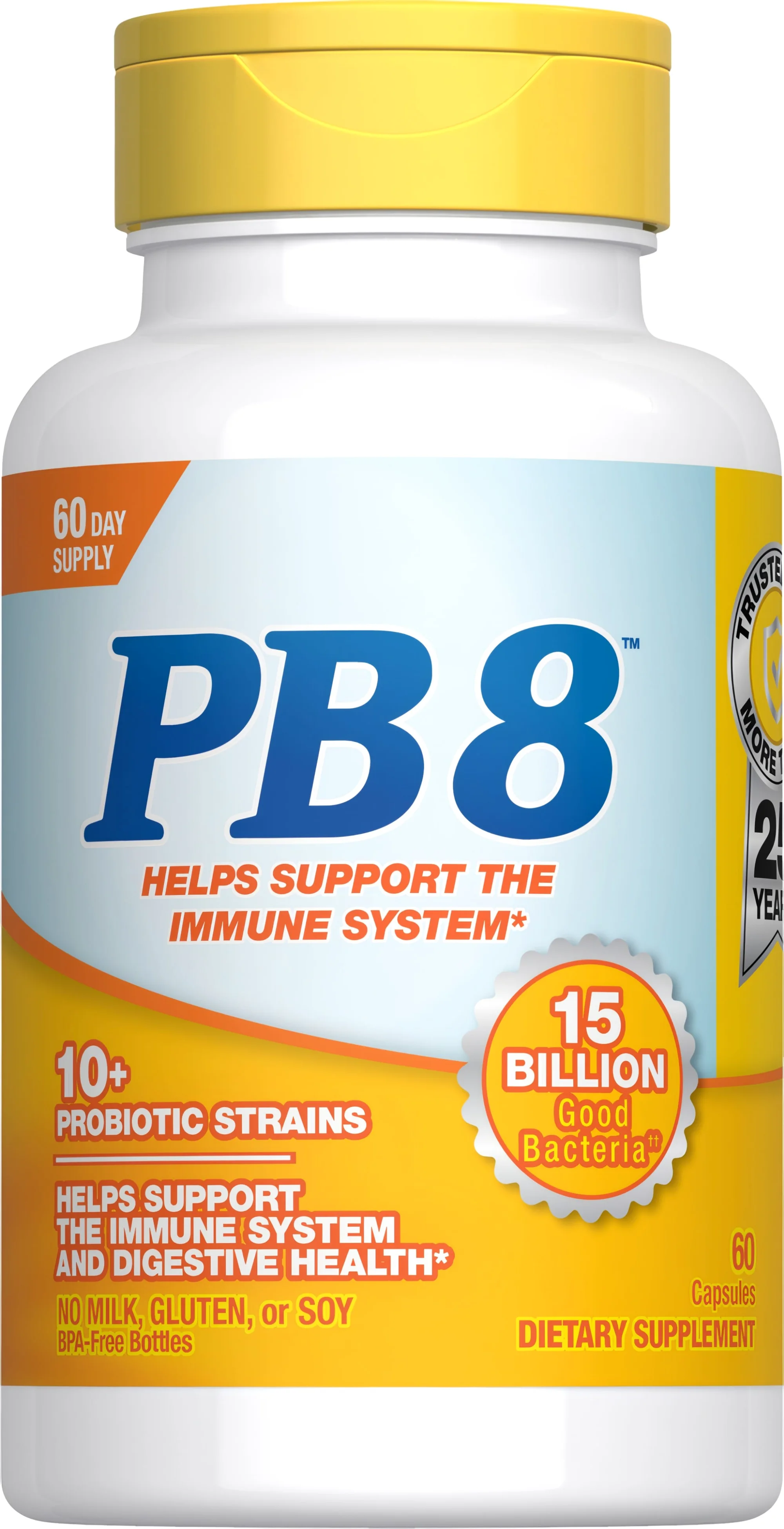
15 billion CFU and 10+ strains in one capsule. 1 capsule a day.

Warnings, and who should ask first
Read the warning box last, but read it. Our labels ask you to seek a health care professional's advice before use if you are pregnant or nursing, take medication or have a medical condition, and the Women's and Vaginal labels add that they are not intended for anyone under 18. The National Center for Complementary and Integrative Health says probiotics have an extensive history of apparently safe use, particularly in healthy people, and that the risk of harmful effects is greater in people with severe illnesses or compromised immune systems.
Take the bottle with you when you ask. A pharmacist can read the whole panel in a minute and tell you whether it fits the rest of what you take. If you want the six labels side by side before that conversation, the comparison page puts every line of them in one table.